


Digitalization of the Mining Industry in Russia in 2026: From Pilots to Practical Efficiency
What digital technologies are in demand among mining companies, what is the main barrier to their implementation, and why is the industry focusing on solutions with a clear economic impact?
The Russian mining industry continues its digital transformation, but in 2026, companies are taking a pragmatic approach to technology implementation. Companies are exploring new solutions and launching pilot projects, but scaling up is proceeding cautiously: key criteria are production efficiency, cost effectiveness, and technological independence.
According to the Kept and Zifra Group study "The Russian Mining Industry: Investments in Digital Technologies – 2026 and a Look Ahead," interest in digital technologies remains strong in the industry, but actual implementation is mostly fragmented or pilot-based. On average, only 10% of companies have plans for scaling and major investments.
What technologies are in demand in the mining industry?
In 2026, businesses will be primarily interested in digital solutions directly related to production process management. According to the study, the most in-demand solutions are:
- dispatching;
- integration platforms;
- AI advisors;
- mining and geological information systems (MGIS);
- Predictive equipment maintenance technologies.
More detailed results of the study show that 81% of companies are using or considering mining dispatching systems, 76% each are using integration platforms and AI advisors, 68% are using the GGIS, and 65% are using predictive equipment maintenance. These technologies enable data aggregation, monitoring of equipment and process conditions, and improving the efficiency of production decision-making.
According to research by Kept and Zifra Group, the most in-demand investment areas by 2030 will remain mining dispatching technologies, integration platforms, and AI advisors.
Companies are relying on their own and adapted solutions
One of the characteristics of digitalization in the Russian mining industry is the high demand for solutions that can be adapted to specific enterprises.
According to the study, 61% of surveyed companies use custom developments or adapted solutions. Kept and Zyfra Group attribute this to the specific nature of the industry and the limited availability of ready-made, off-the-shelf products.
In 46% of cases, companies develop and implement digital solutions themselves, using in-house IT departments. This approach allows for the specifics of production, minimizes the risks of interactions with external suppliers, and reduces the likelihood of sensitive data leakage. However, in-house development can be more expensive.
In-house IT teams are also used to address technological independence. However, as the study notes, in-house development can be approximately 30% more expensive than outsourcing, and the burden of supporting existing systems can slow down the development of new projects.
Digitalization must bring results quickly
Financing digital projects also reflects the industry's pragmatic approach. According to the study, almost half of the surveyed companies-46%-fund digital technology implementation through an investment program. Another 17% use a success fee model, whereby payments are made after the implementation's impact is confirmed.
For 56% of companies, investments in digital technologies do not exceed 2% of revenue, while for another 22%, they range from 2% to 4%. Moreover, 65% of projects are expected to pay for themselves in less than two years. Thus, when choosing digital solutions, companies are primarily focused on specific production tasks and the ability to achieve measurable results.
Mikhail Aronson, CEO of Zyfra Group, noted that digitalization budgets for 2026 have not changed significantly compared to the previous year, and the launch of new projects is significantly limited. The primary funding is being directed toward the targeted implementation of new technologies, supporting existing systems, and improving their efficiency. He characterized the current stage of the industry's development as a period of "pragmatic digitalization."
APCS remains the technological basis
Automated process control systems will become one of the key areas of digital investment in 2026. According to Alexey Yakovenko, Vice President of Transformation at Russian Copper Company, implementing modern predictive models requires first investing in automated process control systems, followed by updating and developing existing systems.
Norsoft's Product Director, Kairat Segizbaev, stated that the company places great emphasis on import substitution, striving to minimize the risks associated with using solutions from foreign vendors. Among the areas he cited were automated process control systems, MES, and modeling systems.
Alexander Bulatov, Director of the Information Technology Department at PhosAgro's Kirov branch, Apatit, described a focus on automated process control systems and the technology stack as a basic minimum, while emphasizing the importance of solutions whose effectiveness has been proven in practice.
Artificial intelligence is moving from experiments to production tasks
Industrial artificial intelligence is becoming another significant area of digitalization. According to Norilsk Nickel's case study, the company's industrial AI competence center consistently generates benefits of approximately $100 million per year. Key components of the enrichment plants-three mills and over 150 flotation machines-have been transferred to automated control based on machine learning. The solutions operate with 95% uptime.
Computer vision is used in real time on over 300 cameras. According to the company, this technology generates approximately $19 million in annual revenue. Another example is an AI-powered virtual sensor that reduced the time it takes to determine sulfur content in enriched products from six hours to 15 minutes, with an average error of 1–2%.
The next step is generative AI. Nornickel has launched a project to implement AI agents and is testing seven processes, from budget control to project documentation compliance. However, the company also notes existing barriers, including a lack of infrastructure for collecting datasets and the operating model's unpreparedness for flexible approaches.
Digital twins are becoming the next level of development
In 2026, digitalization will extend beyond individual management and analytics systems. Polymetal Engineering presented a "Digital Twin of a Mine" that runs in a standard web browser. According to the presented case study, the platform combines point clouds, wireframe models, vector data, 360 panoramas, and photographs in a single environment. Engineers can use it to view the current status of mining operations, compare plans and actual data, and measure distances, areas, and volumes without installing specialized software.
The Karpinsky Institute presents another scale of digital modeling. Viktor Snezhko, Deputy General Director of the Institute, spoke about the national geological mapping resource "Digital Twin of Russia's Subsoil"-a unified multi-scale model of the country's geological structure, updated as new data arrives.
Digital twins, however, require a high level of enterprise readiness: high-quality data, integrated systems, robust connectivity, and mature production analytics. According to the study, they are no longer a standalone digital project, but rather the highest level of an enterprise's digital architecture.
The main barrier is not only technology
Despite the development of digital solutions, enterprises face a host of limitations. According to research by Kept and Zyfra Group, key barriers include lack of connectivity, fragmented data, exposure to dust and vibration, high costs, sanctions, insufficient regulatory frameworks, cyber threats, staff shortages, employee resistance, industrial accidents, and data leaks.
A personnel shortage remains a separate issue. The industry requires specialists who understand both the specifics of mining and digital technologies. Therefore, companies are expanding training, deploying IT specialists to production facilities, and creating cross-functional teams.
Digital transformation requires more than just software. As Andrey Sidorenko, SUEK's chief mining planning expert, noted, modeling efficiency is 50% determined by the quality of the input data, 30% by model tuning, and 20% by model calibration. He added that digital transformation is 80% dependent on people and processes, and only 20% on software.
What awaits the digitalization of the mining industry?
In 2026, the Russian mining industry is moving toward the intellectualization of key technological processes. According to Elena Sapunova, Director of Industry Solutions for the Mining Industry at the IT company CROC, companies will focus on basic automation, industrial neural networks, and an increasing share of domestic solutions. She also highlighted remote control systems, automated geological exploration, environmental monitoring, and predictive maintenance as promising areas.
Digitalization is already being considered a core element of operational efficiency. According to Sergei Bessonov, managing director of the service company Reman-Service, automation and digital platforms are no longer just pilot projects. Remote control of quarry equipment, telemetry-based predictive maintenance, and end-to-end performance analytics are now routinely used.
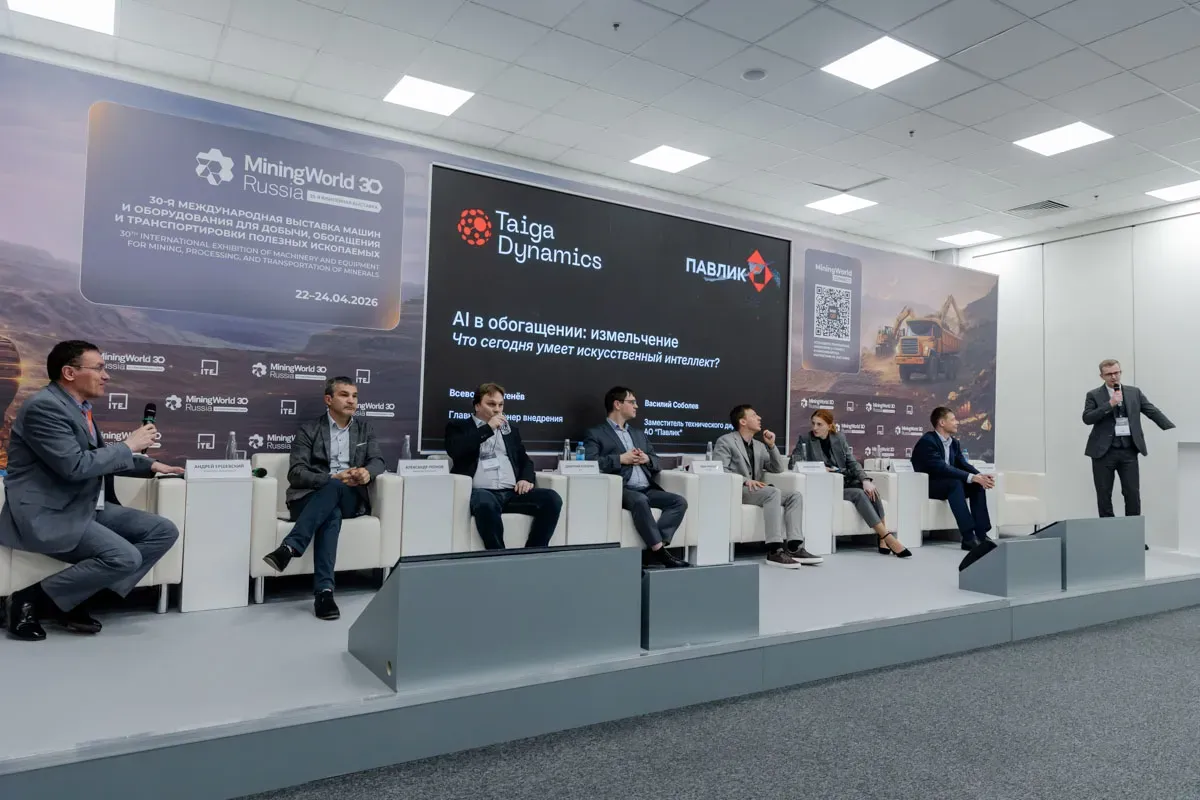
Present digital solutions at MiningWorld Russia 2027
The development of digital technologies is driving growing demand for solutions for automation, robotics, production process management, data management, and efficiency improvements in mining operations. For companies developing and supplying such technologies, MiningWorld Russia 2027 provides a platform for direct communication with industry professionals.
Book a booth in the "IT Technologies, Automation, and Robotics in Mining" section to present your solutions to industry experts and demonstrate their capabilities to those seeking tools for digital business development. In 2026, 23% of visitors were interested in this section.
The business program also included events such as the Business Battle "Digital vs. Production: Who Makes the Decisions and Where to Invest?", the Practical Session "Robotic Technologies in the Mining Industry: From Pilots to Mass Implementation," MINING MES: User Dialogue, Integration Experience, and Identifying System Development Points, the Conference "DIGITAL TECHNOLOGIES AND AUTOMATION OF BURST OPERATIONS," and CYBERGEOLOGY: Neural Networks and Artificial Intelligence in Mining and Geological Exploration.
You can learn more about digitalization through webinars on the MiningWorld Connect platform, such as:
- Safety Technologies: How AI Helps Norilsk Nickel Recognize Threats Before an Accident
- End-to-end management of a mining enterprise based on a domestic MES solution: from concept to industrial operation
- Drilling and boring as a lever for managing production costs: tools and technologies
- Mine to Mill: Where businesses lose millions and how to transform a quarry and a factory into a single system